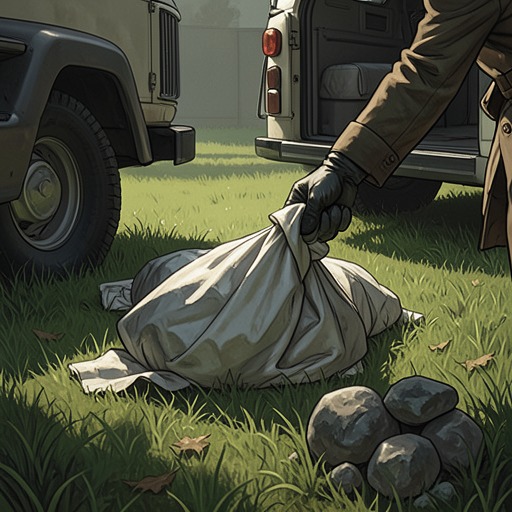
Kacey was burned
I Am LegendKathy Neville’s incineration is the decisive childhood-loss event in Robert Neville’s history: after the plague takes his daughter, authorities remove her body and consign it to the flames. The scene establishes the wound beneath his later isolation and scientific determination. For Robert Neville, the fire is not only a public health measure but the moment when familial love is forced into collision with law, disease, and institutional necessity.
Causes and Circumstances
The event occurs within the emergency regime created by the plague. Funeral parlors are closed, morticians are barred from practicing, and every dead person must be transported immediately to the fires because only flames are believed capable of destroying the bacteria that caused the plague. The policy treats cremation as the only available defense against further communication of the infection, but its universal application removes the possibility of a private farewell.
Robert Neville knows the law and understands the reason given for it. His anguish comes from the gap between knowing that the rule is intended to prevent contagion and accepting what obedience demands from a parent. He imagines husbands carrying the women who shared their lives into the flames, parents surrendering beloved children, and children placing their parents on a bonfire. The generality of the law therefore intensifies rather than diminishes the personal horror: Kathy Neville is reduced to one body among countless plague victims, while Robert Neville experiences her death as an irreplaceable loss.
The Recalled Scene
The memory returns as a violently physical sequence rather than as calm explanation. Robert Neville sees the great fire roaring yellow and sending dense, grease-thick clouds into the sky. Kathy Neville’s tiny body is in his arms when a man in canvas and a mask approaches and snatches her away as though taking a bundle of rags. The man disappears into the dark mist carrying the baby, leaving Robert Neville momentarily fixed beneath the impact of horror.
His grief then becomes resistance. He darts forward with a berserk scream, crying out Kathy Neville’s name, but masked men seize him and drag him back. His shoes gouge two ragged trenches in the earth as he fights them. The physical struggle records a parent’s attempt to reclaim the child even after the authorities have defined the body as contaminated material. A blow to his jaw ends the resistance; daylight passes into darkness, liquor is forced down his throat, and he sits silent and rigid in Ben Cortman’s car while the gigantic pail of smoke rises above the earth like a black wraith.
Immediate Consequences
The incineration leaves Robert Neville with no accepted mourning ritual and no control over the disposition of Kathy Neville’s body. The car ride, the blow, the alcohol, and the smoke become fused in his memory, so that the event is remembered through bodily shock as much as through images. Later, when he encounters the consequences of the plague, the loss of Kathy Neville remains the emotional measure against which other deaths are judged.
The death also helps explain Robert Neville’s resistance when Virginia Neville dies. He recognizes that the law requires her body to be taken to the fires, yet he refuses to submit her to the same fate. He sews her into a blanket until only her face is visible, then covers her mouth, nose, and eyes before burying her himself. His decision is an explicit rejection of the public system that had claimed Kathy Neville. Burial cannot undo the earlier loss, but it gives him a form of agency that the incineration denied him.
Repetition in Memory and Grief
Kathy Neville’s death is not confined to the past. Robert Neville dreams about Virginia Neville and cries out in his sleep, gripping the sheets with frenzied fingers; the dream connects his later bereavement to the earlier destruction of his family. When he encounters a living dog, he invests the animal with extraordinary value because, after so much isolation, it seems to offer the possibility of companionship. He searches desperately when the dog disappears and calls it the peak of a planet’s evolution, then collapses when the animal dies a week after he finds it.
This pattern shows how the loss of Kathy Neville governs Robert Neville’s attachment to survivors. The dog’s illness and death reopen the structure of the original wound: hope briefly appears in a living body and is then taken away. His tenderness toward the dog, including his promise that it will soon be better and his silent tears when it licks his palm, contrasts with the forced violence of the cremation scene. Care becomes the response he was unable to enact when Kathy Neville was seized from him.
Later Meaning and Narrative Significance
The memory also shapes Robert Neville’s understanding of Virginia Neville’s return. He tells Ruth that he buried his wife, but that she came back as an outline or shadow, no longer the same person and driven by the desire to drink his blood. The words reveal why Virginia Neville’s return is not a simple restoration: Robert Neville has already learned through Kathy Neville’s death that the body of someone beloved can remain visible while the person he knew has been irrevocably lost.
The incineration therefore stands at the intersection of private mourning and the novel’s larger transformation of social norms. Public worshippers interpret the plague as divine punishment, a second deluge, and the opening of graves, while Robert Neville confronts the material consequences of infection through bodies, bacteria, fire, and burial. His refusal to burn the dead is emotionally rooted in Kathy Neville’s loss, even as his later investigations pursue the scientific mechanisms behind vampirism.
The event’s deepest consequence is that it makes ordinary human attachment appear politically dangerous. The new infected society later tells Robert Neville that infected people have found a way to remain alive and intend to rebuild society, while eliminating those whom death has cheated. Their planned social order treats Robert Neville and people like him as obstacles to collective survival. Kathy Neville’s incineration foreshadows this reversal: the supposedly normal society had already sacrificed individual bonds to emergency necessity, and the society that follows will use a different definition of normality to condemn Robert Neville. His memory of the fire thus becomes both a personal wound and the origin of his refusal to accept any system that turns beloved bodies into expendable material.